Once again we are coming up to September. Many pilots know that this is the time for the biggest microlight show in Europe - Blois.
Aircreation will be there, as they always are, with a range of their products.
One thing that will be there is the Nuvix wing. This wing is the little brother of the BioniX wing, without the winglets, the vortex inducers and the pressure valves. It is meant for the lower powered trikes and the whole speed range is lower than the BioniX as is the VNE. The good news for many Aircreation owners is that this wing will fit the pre Skypper and Tanarg trikes, giving owners of the older machines the chance to fly a wing with a corset. This will breath new life into older machines.
It is also thought that the new podded version of the Skypper trike could be at Blois. The open version is fine for the general weather that we have in the south of France, but the version with a pod would suit pilots in colder climates.
Aircreation will, as always, have various trike, wing and engine options at the show for prospective customers to fly.
More details of the products can be found at http://www.aircreation.com.
Sunday, 24 July 2011

Monday, 20 December 2010
Another Bionix
Mike Gillam has at last got his BioniX wing. Mike flies in Thailand and has been emailing me with many questions over the past 8 months, but now he has the new wing he is as enthusiastic about it as I am.
Well done Mike, we are looking forward to the latest videos.
Well done Mike, we are looking forward to the latest videos.
Wednesday, 8 December 2010
BioniX is selling
The BioniX wing seems to be selling all over the place.
Mike in Thailand is waiting for his to be delivered. I will be be happy when he gets it as he has made some great flying videos, that will be even better with a wider speed range. See his videos on his blog at http://mikethaitanargadventures.blogspot.com/
Henry, in the US has had his delivered. Henry is another great video maker and editor. Henrys videos can be watched on www.trikepilot.com.
My mate Derek came over from the UK this summer to visit. He very kindly brought me a years supply of PG Tips tea bags (can't get them in France), so as a reward I took him for a BioniX flight. He ordered his within a week! He is flying it in New Zealand this very day. He still has his Tanarg/iXess in the UK, but that is because the BioniX is still not certified in the UK.
I have not heard back from the factory about the fuel gauge option. My email must be another of those that have disappeared into the ether!
Wednesday, 17 November 2010
Bionix SB
There is a new service bulletin out for the BioniX wing. Please see http://www.aircreation.fr/anglais/Technical/Servicebulletins/tabid/155/language/en-US/Default.aspx for the English language version.
Tuesday, 9 November 2010
Fuel guages
Now that Aircreation has the Skypper, complete with dashboard mounted fuel gauge, I thought it would be a good idea to investigate the chances of fitting the same to a Tanarg.
Many of the Top end Tanargs come with the Enigma EFIS dashboards these days, which come with a fuel contents display. This means that they must have a fuel sender in the tank. The sender that the Skypper uses will probably be no use on the Tanarg due to the different fuel tank shape. The gauge will fit though.
It is a pain to look down under the passengers leg to see the fuel tank contents. A gauge on the dash would be a good backup indicator of fuel contents.
I will report further when I get an answer to my email to the factory.
Wednesday, 6 October 2010
The Skypper
Ok so you have seen the pictures, but what is it really like?
Well it is a similar sized trike to the P&M offering. The design is very light and strong with a modern looking welded steel structure. It is superbly configurable with the choice of 3 engines and many different wings. An option for a detachable full pod may be available in the future, making it suitable for climates like the UK. The small pod as fitted to the ones in the pictures on my last post is, in fact, very good. With the windscreen design there is very little buffeting or wind noise for the pilot at least.
Flying it seems very similar to the Tanarg with the same wing, but you can feel that there is less weight in the machine, and the 80hp rather then the 100hp of the Tanarg is not noticeable.
Production will start in November this year, there are still some minor modifications being made in comparison to the trikes in the pictures, Aircreation will not release anything until it is as perfect as they can get it!
The fuel tank has a sight tube on the side to easily read the fuel contents, but a fuel gauge on the dashboard is a factory option. The seating is not cramped at all, in fact I would say that it is less cramped than a P&M GT450, but it will be a better machine for flying instruction than the Tanarg due to the controls being in easier reach for the instructor. All the trikes at Blois had the dual controls fitted, and I assume that this is a factory option for the Skypper.
Prices have not yet been released, but I would expect that it will be about €10,000 less than the equivalent engined/wing Tanarg. If you want the prices then contact the factory or your local Aircreation dealer.
Monday, 4 October 2010
The new Aircreation Skypper

The Skypper 582 fitted with the iXess wing.

The 582 again showing the sleek lines of the trike.

Rotax 582 engine fitted.

The 912 engine and Bionix wing version.

The same one again.

The Skypper and its big brother, the Tanarg.

The Skypper folded ready to fit a wing.

Very modern design of the Skypper front end.

HKS engine version.

Neat and tidy side view showing strong suspension.

BioniX wing showing the Kevlar band in the wing.

Brothers, both with BioniX wings.

Skypper 912/BioniX take off.
The design of the Skypper is very clean and modern looking. It is a bit smaller, and lighter, than the Tanarg, about the same trike size as the P&M range of flexwings.
It comes with a choice of three engines, the 65hp Rotax 582 two stroke, the 60hp HKS four stroke or the 80hp Rotax 912 four cylinder four stoke. Any of Aircreations current range of wings can be fitted, as seen in the pictures above.
More to follow!
Sunday, 3 October 2010
BioniX and things
What has been happening over the past year or so?
Aircreation launched the new trike called the Skypper at Blois this year, more about that later.
The Bionix is now a year old since the first sightings at Blois last year. The first service bulletin was issued at the end of July this year.
The problem stems from the plastic fairings that cover the A frame and kingpost. The velcro on the trailing edges of these fairings is not strong enough and can part. This leads to a very severe vibration trough the control bar at certain speeds.
The factory may have designed new fairings, and they are available for existing owners with the old fairings fitted.
I have had a few conversations with Tanarg pilots in the USA asking why Aircreation do not answer emails. The response is that I do not know! I don't work for Aircreation, but happen to know that they are having problems with the email at their end, a solution may be in the pipeline - watch this space.
If you need to contact the factory then phone them on a weekday morning and you should speak to Gabriel, who speaks English. Another option is to send a fax. Their numbers are on their website at http://www.aircreation.com/anglais.
Friday, 1 October 2010
The blog is back
Thanks to those people who sent requests to view the blog. It was closed for personal reasons, but it is now back!
Thursday, 15 April 2010
Still playing

While the BioniX is very easy to fly and land, I have found that it needs some practice to get the best out of it. The slow speed handling is fantastic, but on my short strip it needs some thought. I found that on a couple of landings, I was coming in too high. The natural thing to do is to pull the bar in a little, but what happens is that the speed increases and so does the lift. The trick is to push the bar out further. It will not stall in the same way as a normal wing, but will lose height and come down like a helicopter, with very little forward speed.
I have played a bit with the higher speeds, and have flown hands off at 80 mph (130kph). Even with the bigger windscreen this gets quite noisy and find that about 70 to 75 is more comfortable.
We flew back from Domme last Sunday afternoon. It was a hot afternoon after a very cool night. There was plenty of moisture in the ground and the cumulus clouds were building. Flying back at between 2000 and 5000 feet was very turbulent, but I can say that the BioniX is much better behaved than the iXess 15 was. Had we been flying the iXess then I suspect that my wife would have had me land at Gallinat halfway home as she does not like the bumpy air!

Tuesday, 16 March 2010
My very own BioniX
Flew the BioniX again today and I am blown away with the capabilities of the wing. It was a thermic day, but was not difficult flying, the wing handles the thermals much better than any wing I have ever flown before. The only other wing that I remember was better than most in these conditions, was the old Raven wing.
After racing around the sky at decent speeds, I set it up into the slow position for landing. I would think that the touchdown speed was not much more than 30 mph (50 kmh) and did not have the slightest hint of a stall. After touchdown I applied the three hydraulic disk brakes that my Tanarg is fitted with and stopped in about 20 metres. That was with 2 people and around 30 litres of fuel aboard - amazing.
Those who can see this blog are the chosen few at the moment, it will be open for all again in a couple of months.
Thursday, 11 February 2010
The blog is back!
Sorry if you have tried to see what is going on in my Tanarg world, but for reasons that I am not going to divulge, the blog has been locked for a while.
It will now be visible to selected people for a while and will be opened up for the world to read at a later date.
I should be taking delivery of the BioniX wing next week and will report further when I have it.
It will now be visible to selected people for a while and will be opened up for the world to read at a later date.
I should be taking delivery of the BioniX wing next week and will report further when I have it.
Sunday, 29 November 2009
Flight test text
As many people don't seem to want to register on the Av8magazine site, I have copied the text here:
This is going to be a very difficult thing to write about!
On Thursday the 19th of November I found myself at the Aircreation factory in Aubenas, France. The weather was a warm 16 degrees C with light winds. As I stood in front of the gold painted Tanarg fitted with the revolutionary BioniX wing, I thought that this was going to be one of those days that I would remember for a long time.
The Tanarg is the standard Rotax 912S engined flexwing, fitted with the Enigma dash and a ballistic parachute. The MTOW for this machine is 472 kgs here in France. There is very little difference between this and the Tanarg that I normally fly, apart from the parachute fitted to this one and the iXess15 wing fitted to mine. I had considered fitting an iXess13 wing to mine for a little extra speed, but would loose out on the short strip performance. Then there is the BioniX wing!
The BioniX incorporates a few bits of technology which are not normally seen on flexwing microlights. First is the “Corset” as Aircreation describe it. Instead of having a trim wheel on the right of the control bar, there is a handle to turn. This tightens the cables in the corset and changes the profile of the wing. On a standard trim wheel the wing is set up for a particular speed and any deviation from that speed, be it faster or slower, is a compromise. By changing the profile, as the BioniX does, the optimum speed is changed from slow to fast or vice versa, this means that in any position of the corset the wing is flying efficiently at different speeds. A conventional trim on normal flexwings pulls up the trailing edge of the wing and moves the bar forward or rearward so that the pilot does not have to hold any pressure to fly at differing speeds. The “Corset” changes the profile so that the control bar stays in the same position whether it is in fast or slow mode. This has the advantage of allowing full forward or rearward movement of the bar at any trim speed. The nearest comparison to this on military aircraft is the swing wing design.
Another interesting feature is that the wing has vortex inducers on top of the leading edge on the inboard part of the wing. Then there are the quick release baton tips on the trailing edge of the wing, which look more aerodynamic than the usual tied chords.
When it was time to fly the aircraft, the Aircration instructor sat in the back with me in the front and 40 liters of fuel on board. We taxied out to the short runway. After few checks, one to make sure that the handle was in the slow position, I pressed the throttle and within 60 meters or so was airborne. I climbed out at about 6 to 7 meters per second (1200 to 1400 ft/min), this was impressive compared to my wing. We leveled out at around 1200 feet and I played with the throttle. At a mere 65 to 70 kmh (40 to 45 mph) the wing felt completely in control, it was light in both roll and pitch and felt like it was flying rather than getting close to the stall – which it was not. I set the hand throttle at 4000 rpm and let it build up speed till it was straight and level at just over 80 kmh (50 mph). With the throttle fixed I turned the “go faster” handle and kept it level. When in the taught (fast) position it was flying at around 125 kmh (75 mph), the wing felt exactly the same as in the slow mode, very light and stable. At this point I opened the throttle and put a little back pressure on the control bar to keep the aircraft at the same level and found myself at just over 150 kmh (94 mph). The only difference was the buffeting around my flying helmet! It would have been happy sitting there all day. But speed is not what this wing is about.
We turned towards the airfield and slowed the machine down to 65 kmh again for the approach. It just floated toward the end of the short runway. There was no swinging about with the slight winds and the control felt very secure. Just above the end of the runway the instructor told me to push the bar out to the front strut, this is not something that I would normally do as a stall would result in a heavy landing, but not the BioniX, it just flew slower and slower until it touched down. I estimate the distance from rear wheels touching the runway to full stop as less than 30 meters.
We did not taxi back to the end of the runway for another take off, we just opened the throttle and were off again in no time. Aubenas is in a mountainous area with hills all around and I expected a little turbulence when flying low, but if there was any, the BioniX did not react to it at all.
On the second flight, I tried a spiral dive in the slow mode and the same in the fast mode, both felt fully controlled and as if the machine knew what I wanted to do before I did. To fly a fast, stable and lightly controlled microlight and then fly a slow stable microlight in one flight has to be a strange experience for any flexwing pilot.
I checked the fuel after the hours flight and would expect that it used around 10 liters per hour. This is on a par with the wing on my machine, but at a slightly higher weight. In normal flying, I would think that with less drag the BioniX may be a bit more economical than mine in the cruise.
The Tanarg has to be the most comfortable flexwing on the market with the large, well padded seats and the fully adjustable footrests, the BioniX wing is just the icing on the cake. The combination has now also become the most versatile. I can imagine that this would make an ideal aircraft wing combination for a small flying school where the instructor trains on the machine in the slow mode, and then goes touring in it too.
That afternoon, my wife went up in the back seat, she is not a pilot but a passenger, and has only been that for about 2 years. The instructor switched the engine off in the air and performed some manoeuvres to show her how it flies. They landed without the engine. She commented afterwards that it was the smoothest flight that she had ever had, and that it will be a great photographic platform for her due to the slow speed performance.
The instructor has a Tanarg of his own. He has two wings for it, an iXess 15 and a 13, one he flies in the Alps and one that he flies near Aubenas. His comment that he will sell both and have one BioniX, is testament that this is a very versatile wing.
It is very difficult to put the experience of this flight into words and I would encourage others to fly the BioniX to feel the difference between this and “normal” wings, I have not yet met anyone who has flown it and does not think that it must be the future of flexwing microlights.
Should anyone want to order a BioniX, it will fit any Aircreation Tanarg trike, but be quick because there will be a large order book.
Two interesting web pages about the BioniX can be found on the Aircreation website at:
http://www.aircreation.fr/anglais/Products/FAQBioniX/tabid/187/language/fr-FR/Default.aspx
and http://www.aircreation.fr/anglais/Products/Wings/BioniXWing/tabid/186/language/fr-FR/Default.aspx.
Thursday, 26 November 2009
Flight test
A flight test on the BioniX has been published in the online aviation magazine at www.av8magazine.com.
You have to fill out a quick registration to read the magazine, but it is not something that will lead to any emails other than a reminder every month when the new issue comes out.
You have to fill out a quick registration to read the magazine, but it is not something that will lead to any emails other than a reminder every month when the new issue comes out.
Monday, 23 November 2009
Pictures of the BioniX
 This first picture shows a Tanarg with iXess wing landing. Note that the machine is being flown solo and the position of the control bar in relation to the front strut. This is the normal way to land a flexwing.
 This one shows us landing in the Tanarg with a BioniX wing. We are two up, so heavier, and are probably flying much slower than the Tanarg in the first picture. Note that in this one that the control bar is just about touching the front strut, but the machine was very stable and sure footed, at no time did it feel that it was going to stall.
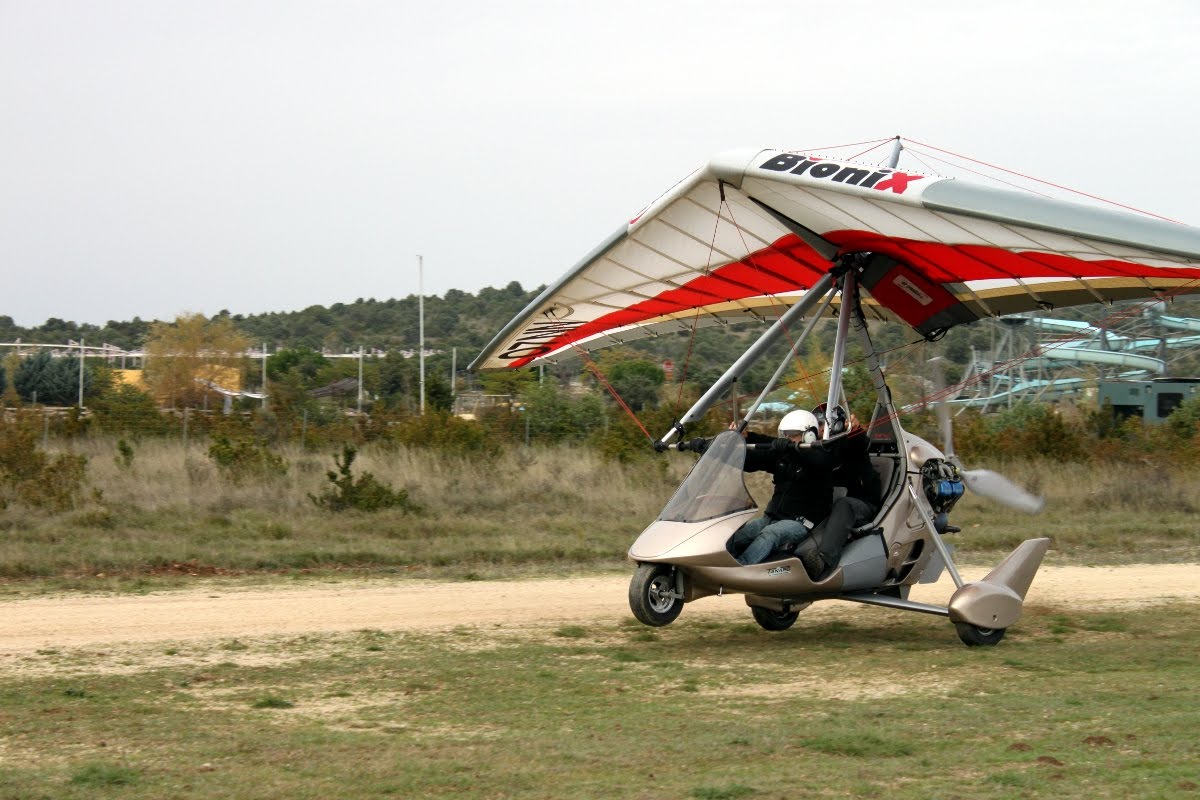 The picture above shows the point of touchdown when landing in the other direction. At this point the machine was flying very slowly. The photographer was standing at the edge of the runway.
 This is the point of full stop! These last two pictures show that this wing is capable of landing in a very short space. This is a fantastic safety feature as the Tanarg is fairly heavy with two people, fuel and a parachute fitted. In an emergency, any small field would be enough for the BioniX.
Flying the BioniX
The next edition of the online magazine, www.av8magazine.com, will have the flight test write up of my flight.
I will not post the full text here just yet, but have to say that it was very difficult to write what I experienced. What I will say is that I was blown over by the flight.
To fly a flexwing at 150 kmh and 10 minutes later, be flying the same machine at 70 ish kmh, was an eye opener!
I will not post the full text here just yet, but have to say that it was very difficult to write what I experienced. What I will say is that I was blown over by the flight.
To fly a flexwing at 150 kmh and 10 minutes later, be flying the same machine at 70 ish kmh, was an eye opener!
Sunday, 22 November 2009
Flight test day
We flew the Tanarg/BioniX combination last week on Thursday. After lunch Franck, the instructor, took my wife for a flight in the back seat. She loved the machine and had great fun when Franck turned the engine off in flight.
Note how slow the BioniX is capable of flying, and how Franck can push the bar out to the front strut on the approach without any fear of the wing stalling.
Note how slow the BioniX is capable of flying, and how Franck can push the bar out to the front strut on the approach without any fear of the wing stalling.
Saturday, 21 November 2009
First Englishman flies the BionIX
I have at last flown the BioniX - on the 19th of November. You will have to wait for me to get off this high to see what I think!
Tuesday, 10 November 2009
The Bionix flying
 These pictures were taken after a day of waiting for the rain to stop and the wind to slow a little. We were at a small microlight strip to the south.
 As the rain stopped but still with a cross wind, the Aircreation pilot took the Tanarg/ BioniX up for a weather check.
 At the time Jude was sat in the car reading a book, but was quick with the camera when she heard the machine coming in to land.
 I have uploaded the pictures in a decent resolution so that people can download them and use them as wallpaper on their PC desktop.

Click on the photos to see bigger pictures.
Thursday, 22 October 2009
AirCreation website update
The factory website has now been updated to give more English language content. the link is AC English website.
If you click on the part that reads "Corset presentation English A4" You will see the technical description of the corset in .pdf format.
The "CTP BioniX_en" now has imperial performance measurements as well as metric.
If you click on the part that reads "Corset presentation English A4" You will see the technical description of the corset in .pdf format.
The "CTP BioniX_en" now has imperial performance measurements as well as metric.
Subscribe to:
Posts (Atom)

 Posts

